
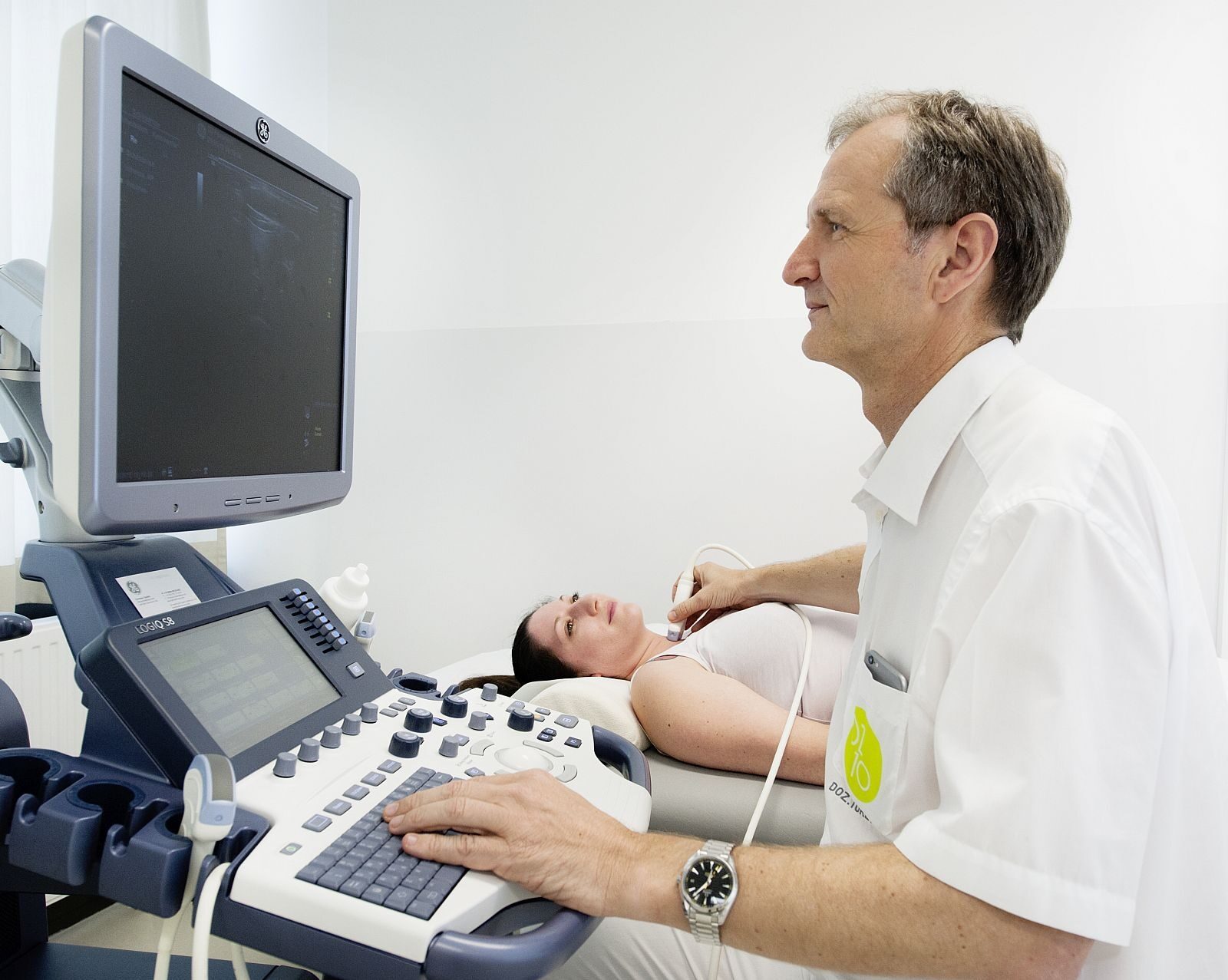
Ultrasound
No harmful radiation is used in ultrasound. High-frequency sound waves are sent into the body, which are reflected and picked up again by the transducer. This allows the examiner to directly assess the various organs.
Frequently asked questions (FAQs)
Which organs are examined using ultrasound?
In principle, ultrasound can be used on all organs, with the exception of organs filled with air (lungs and gastrointestinal tract) and bones, as these cannot be assessed by ultrasound.
I am pregnant, can I have a sound?
Yes, ultrasound has no harmful effect on the baby, nor does the direct examination of the embryo in the womb have any harmful effect.
What do I need to consider for the examination?
For the sonography of the upper abdomen, we ask you not to eat for 3 hours so that the gallbladder has not collapsed and there is not too much air in the stomach, which restricts the examination conditions. Drinking still water is permitted.
We therefore also try to carry out the examinations in the morning. We ask you to take your medication with a sip of water in any case.
For the sonography of the lower abdomen, we ask you to come with a full bladder, as this improves the examination conditions.
For sonography of the neck vessels in men, a fresh shave optimizes the image quality.