
All insurances & private
Bone density measurement
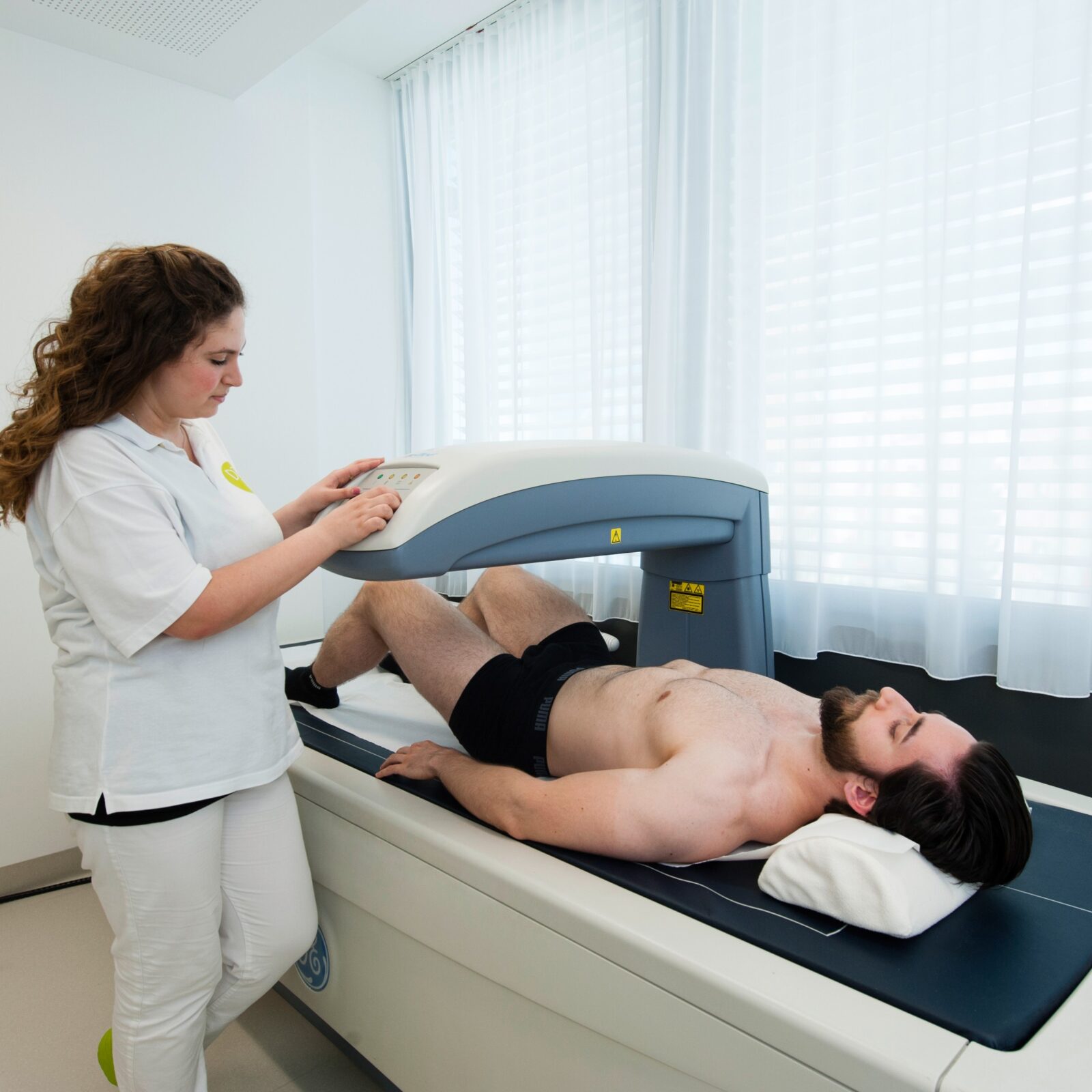
Bone density measurement is used to diagnose pathological bone loss and serves to detect bone loss (osteoporosis) at an early stage or to monitor treatment in the case of an already known disease. In this examination technique, the bone mineral content is determined using a low level of X-ray radiation. For an exact evaluation, a current X-ray image of the lumbar spine is also required, which can be taken directly before the bone density measurement.
Recommendation & costs
- Early diagnosis of bone loss enables early prophylactic medication.
- Menopausal women and men over 50 are particularly at risk.
- Examination recommended: Women from the age of 65, men from the age of 70. An earlier examination is advisable if there are additional risk factors.
- Regional health insurance covers costs: women from 65, men from 70.
- Small insurance companies cover costs without restriction.
Risk factors
- Fractures without trauma
- Hereditary burden
- Prolonged cortisone therapy
- Underweight, malnutrition
- Lack of physical activity
- Chronic joint or intestinal inflammation
- Lactose intolerance
Frequently asked questions (FAQs)
What is the radiation exposure of the bone density measurement?
X-rays are used to measure bone density. The radiation exposure of modern DXA devices is around 1 to 6 µSv, which is many times lower than the average annual radiation exposure from the environment (earth radiation and radiation from space: around 2000 µSv)
What can be assessed in a bone density measurement?
The doctor can assess osteoporosis with the help of bone density measurement. The examination is used for